Procurement Risk Control Matrix With 8 Practical Examples
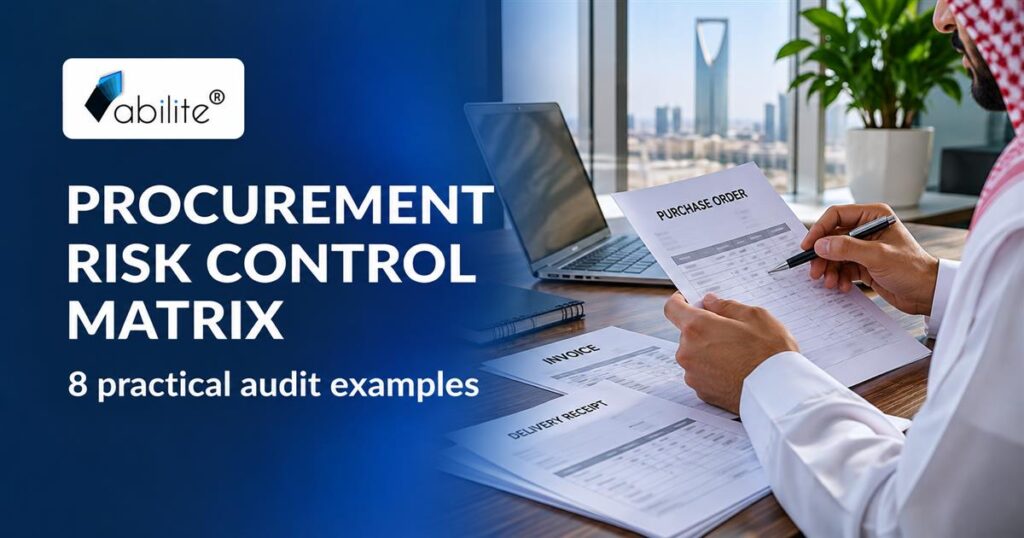
A supplier’s invoice can have a purchase order, an approval and a payment record—and still contain a problem nobody tested. The documents matter, but the audit needs to establish what they prove.
A procurement risk control matrix connects each purchasing risk to a specific control, the person responsible, the evidence retained and the audit procedure used to evaluate it. The examples below show how to build that connection across a procurement engagement.
For Saudi internal audit teams, this is a useful way to organize work across purchasing, receiving and finance. It is also relevant to teams elsewhere. The examples are fictional and should be adapted to your systems, approval limits and engagement scope.
What a procurement risk control matrix should record
Start your procurement risk control matrix with the objective of the process. For example: buy approved goods and services from suitable suppliers, receive what was ordered and pay the correct amount to the correct account.
Then describe a risk as an event with a consequence. “Supplier risk” is too broad. “An unauthorized bank-detail change diverts an otherwise valid payment” gives the auditor something specific to examine.
For each risk in your procurement risk control matrix, record the control action, owner, frequency, evidence, audit procedure and conclusion. A statement such as “finance checks invoices” leaves several questions unanswered. What is checked? When? Against which records? What happens to an exception?
Eight procurement risk control matrix examples
The controls below are illustrative practices, not a statement that each control exists in Abilite or is mandatory for every company. Sample sizes and test periods should follow the approved audit methodology.
On a phone, swipe across the table to see the controls, evidence and audit tests.
| Area | Risk and consequence | Illustrative control | Evidence and audit test |
|---|---|---|---|
| 1. Supplier onboarding | A fictitious or unsuitable supplier enters the master file and receives business. | A designated reviewer checks onboarding information and approves supplier creation independently of the requester. | Inspect the supplier population and selected new records; trace identity checks and approval before activation. |
| 2. Bank-detail changes | A fraudulent change redirects a valid payment. | An independent approver verifies a change through an established supplier contact before it takes effect. | Compare change logs, verification records and approvals; check whether verification preceded activation and the first payment. |
| 3. Purchase approval | Orders exceed delegated authority or bypass approval. | The organization applies its approved authorization limits before issuing a purchase order. | Inspect the authority matrix effective at the transaction date; compare selected orders, approvers, amounts and timestamps. |
| 4. Order splitting | Related orders are split to avoid an approval threshold. | A reviewer examines related purchases for patterns that require escalation under company policy. | Analyze orders by supplier, requester and period; investigate selected clusters and inspect documented follow-up. |
| 5. Goods and service receipt | The organization pays for goods or services not received. | A responsible recipient records acceptance separately from invoice processing. | Trace selected invoices to receipt or service-acceptance evidence; investigate missing or inconsistent records. |
| 6. Invoice matching | Quantity, price or terms differ from approved purchasing records. | An invoice is checked against the relevant order and receipt or acceptance evidence, with exceptions approved before payment. | Inspect matching records and tolerances; trace selected exceptions to an authorized resolution. |
| 7. Duplicate payments | The same obligation is paid more than once. | A defined duplicate-check process examines invoices and payment proposals, with review of flagged exceptions. | Test the completeness of the selected payment population; examine possible duplicates and the evidence supporting their resolution. |
| 8. Access and separation of duties | One person can create a supplier, alter payment details and release payment without independent review. | Access assignments and compensating reviews reflect the organization’s approved responsibilities. | Review relevant user access and selected transactions; inspect approvals, conflicting permissions and evidence of compensating review. |
How to test your procurement risk control matrix
A policy can describe a sensible control while the process operates differently. Separate the assessment of design from the assessment of operation.
First, decide whether the control could address the risk if performed as described. Then examine whether it operated during the audit period. A screenshot of a configuration may support the first question but may not answer the second.
Document the population, period, selection approach, evidence examined and exceptions. If records are missing, explain the limitation rather than treating the absence of an exception as evidence that the control worked.
Using a procurement risk control matrix in a Saudi company
Agree the scope with the process owners before requesting records. A procurement engagement may involve local and overseas suppliers, shared-service teams and several approval systems. Identify which company, location and period the work covers.
Keep policy requirements separate from regulatory references. A rule applying to one sector or public entity should not be presented as a universal requirement for all Saudi companies. Have the appropriate specialist confirm applicability before including a legal or regulatory requirement in the matrix.
The IIA’s Middle East Risk in Focus 2026/2027 identifies supply-chain concerns and the need for flexible audit coverage. That makes procurement a relevant area to consider when refreshing a risk assessment; it does not make this example a prescribed audit plan.
From the matrix to an audit program in Abilite
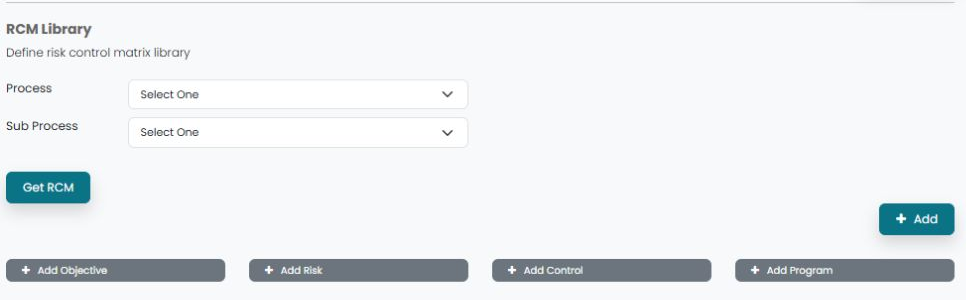
Abilite’s published RCM instructions show a sequence for adding an objective, a risk, a control and an audit program. They also show that a risk can have multiple controls.
Use those connections to explain the purpose of the work. The objective establishes what the process should achieve. The risk identifies what could prevent that outcome. The control describes the response. The program sets out the audit work.
The example table includes planning fields for a practical engagement. It does not mean every column is a separate Abilite field, that Abilite performs the suggested analytics automatically, or that it replaces your purchasing or payment system.
Read the Abilite RCM library guide for the actual product steps and screenshots. IIA-Australia’s public factsheet description also distinguishes a documented engagement work program from a mandatory template format.
Bring one process to the demonstration
Choose one procurement process your team currently reviews. Bring an anonymized objective, risk, control description and audit procedure. Ask the Abilite team to demonstrate how those records connect, how the matrix is updated and what reviewers need to check.
English and Arabic interfaces and cloud or on-premise deployment options are available. Confirm implementation responsibilities and the workflow you need during the demonstration.
Book a 30-minute Abilite demo or review Abilite for Saudi audit teams.
Common questions
Is this a complete procurement audit checklist?
No. It is an illustrative set of risks, controls and procedures. Your audit scope may also cover sourcing, contracts, inventory, supplier performance or other areas that need additional work.
Is a risk control matrix required in one fixed format?
A documented engagement work program is important, but a single universal RCM format is not prescribed. Select a structure that supports your engagement objectives and methodology.
Can this example be used for Saudi regulatory compliance?
It can support planning, but it is not a compliance certification or a complete regulatory checklist. Confirm which requirements apply to the organization and sector before adding references or conclusions.
Does Abilite automatically prevent duplicate supplier payments?
This article does not make that claim. The duplicate-payment row is an illustrative control and audit-test example. Confirm any required analytics or integrations directly during your product evaluation.
Can we see the RCM workflow before deciding?
Yes. Book a 30-minute Abilite demonstration and bring an anonymized example so the discussion can focus on your team’s actual workflow.