
IIA 2024 Standards Fix Critical Audit Gaps Fast
If your internal audit function is still relying on legacy frameworks, transitioning to the IIA 2024 standards is no longer something to push off to next quarter. The updated IIA 2024 standards bring a much needed, practical shift to how risk teams structure documentation, engage with audit committees, and demonstrate value.
This guide covers what changed, what the five domains actually mean in practice, and a step-by-step checklist your team can use to confirm conformance. Most teams working through this transition find it also surfaces the need for structured internal audit software to manage the documentation and evidence requirements the new standards introduce.
What are the IIA 2024 Global Internal Audit Standards?
The IIA Global Internal Audit Standards were released on January 9, 2024 by the Institute of Internal Auditors and became mandatory for all internal audit functions on January 9, 2025.
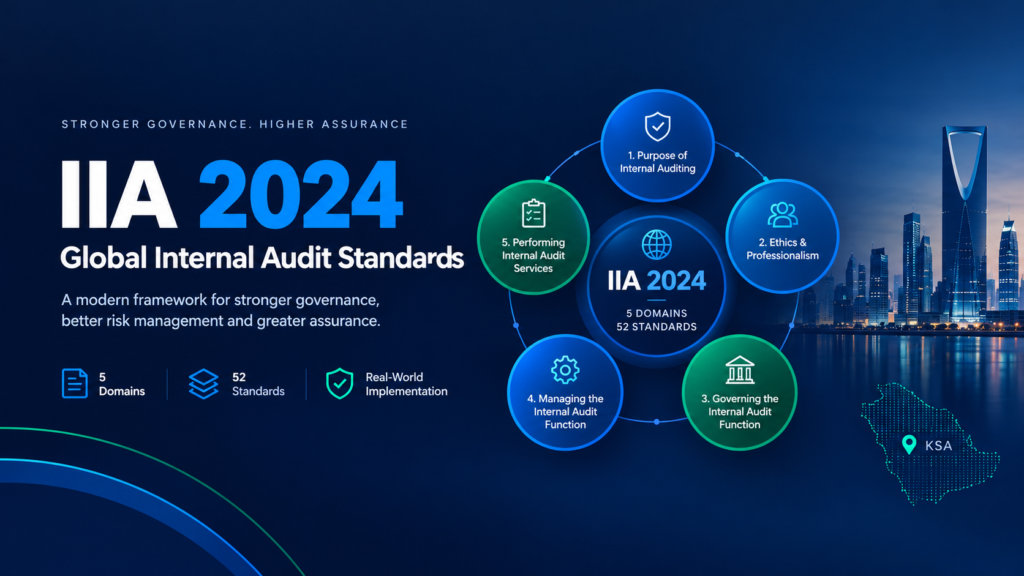
They replace the 2017 International Standards for the Professional Practice of Internal Auditing. The 2017 version was built as five separate mandatory documents. The 2024 version consolidates everything into one framework: 5 Domains, 15 Principles, and 52 supporting Standards.
Each Standard contains three components:
- Requirements — what an internal audit function must do
- Considerations for Implementation — how to apply the requirement in practice
- Examples of Evidence of Conformance — what documentation demonstrates you are meeting the standard
The standards apply to all internal audit functions globally, regardless of size, sector, or geography.
What changed from the 2017 standards to IIA 2024?
The 2024 standards are not a minor update. They represent a structural overhaul of how internal audit functions are expected to operate, document, and report. The key changes are:
- Single consolidated document. The five separate mandatory elements of the 2017 framework are combined into one. The old split between attribute standards, performance standards, and implementation standards is gone.
- New Domain structure. The 2017 standards organized requirements into two categories. The 2024 standards use five Domains that cover the full lifecycle of an internal audit function, from purpose and ethics through governance, management, and delivery.
- Stronger Audit Committee governance. The standards introduce an entirely new section on governing the internal audit function. The board and audit committee now have explicit, defined responsibilities, not just the Chief Audit Executive.
- CAE independence confirmation required annually. The Chief Audit Executive must formally confirm organizational independence to the audit committee on an annual basis. This was encouraged under the 2017 standards. It is required under 2024.
- Finding ratings now recommended. The 2024 standards recommend that internal audit findings include a rating or ranking, a priority level that tells management and the board how serious each finding is. This is not mandatory but is listed as better practice in the Considerations for Implementation.
- Risk-based planning is explicit. The 2017 standards implied risk-based planning. The 2024 standards make it explicit, audit plans must be derived from a structured risk assessment and updated when the risk environment changes.
- Quality assurance requirements strengthened. External quality assessments are still required every five years. Internal assessments must now be more systematic and the results communicated to the audit committee.
The 5 Domains of the IIA 2024 Standards explained
The five domains are the structural backbone of the 2024 standards. Every one of the 52 supporting Standards sits within one of these domains.
Domain 1 — Purpose of Internal Auditing Defines why internal audit exists and what it is meant to contribute to the organization. Covers the definition of internal auditing and the mandatory elements that every internal audit function must uphold.
Domain 2 — Ethics and Professionalism Covers the Code of Ethics that all internal auditors must follow, integrity, objectivity, confidentiality, and competency. Also covers ongoing professional development requirements for the audit team.
Domain 3 — Governing the Internal Audit Function This is the most significant new domain. It codifies the board and audit committee’s responsibilities in establishing, supporting, and overseeing the internal audit function. The audit committee must ensure the function is adequately resourced, appropriately positioned, and operationally independent. For Saudi organizations, this domain maps directly to SOCPA governance requirements.
Domain 4 — Managing the Internal Audit Function Covers how the Chief Audit Executive runs the function, strategic planning, resource management, quality assurance, policies and procedures, and communication with senior leadership. The annual audit plan, resource allocation, and performance reporting all sit here.
Domain 5 — Performing Internal Audit Services The operational domain. Covers how individual audit engagements are planned, executed, documented, and reported. Finding management, evidence collection, engagement communication, and follow-up all fall under Domain 5. This is where most of the day-to-day work of an internal audit team happens.
What IIA 2024 means for internal audit teams in Saudi Arabia and GCC
For Saudi internal audit teams, the 2024 standards matter beyond IIA membership requirements. SOCPA, the Saudi Organization for Certified Public Accountants, has aligned its governance expectations with IIA 2024. Listed companies and regulated entities in the Kingdom are expected to demonstrate conformance with the new framework.
At the same time, Saudi audit functions are dealing with requirements that do not exist in most global IIA guidance: NCA Essential Cybersecurity Controls audits, ZATCA tax compliance reviews, and SAMA framework requirements for financial institutions. The 2024 standards are broad enough to encompass all of these, but applying them to the Saudi context requires deliberate mapping rather than a generic implementation.
The teams managing this transition most effectively are the ones that have moved their audit programmes off spreadsheets and into structured platforms. Almana Group of Hospitals in Saudi Arabia manages their IIA 2024 aligned audit programme across multiple hospital units on Abilite, they cut audit planning time by 60% and now deliver real-time audit committee reporting without manual compilation.
For GCC teams navigating IIA 2024 alongside local regulatory frameworks, purpose-built internal audit software for Saudi Arabia makes conformance documentation significantly more manageable.
How to implement IIA 2024 standards: a practical checklist
This checklist covers the core steps for an internal audit function transitioning to the 2024 standards. It is not exhaustive, the full implementation guidance from the IIA goes into greater depth, but it covers the actions that most teams need to prioritize.
Step 1 — Conduct a gap analysis against the 52 Standards. Map your current policies, procedures, and practices against each of the 52 supporting Standards. Identify where you already conform, where you partially conform, and where gaps exist. This is the starting point for everything else.
Step 2 — Update your audit charter. The audit charter should reference the IIA 2024 Global Internal Audit Standards specifically. It should reflect the updated independence requirements, the CAE’s relationship with the audit committee under Domain 3, and the function’s mandate under the new framework. Present the updated charter to the audit committee for formal approval.
Step 3 — Align your annual audit plan to Domain 5 requirements. The audit plan must be risk-based, documented as such, and approved by the audit committee. The 2024 standards are more explicit about what a risk-based plan looks like than the 2017 version was. If your planning process is not visibly connected to a current risk assessment, update it.
Step 4 — Establish the CAE independence confirmation process. The Chief Audit Executive must confirm organisational independence to the audit committee at least annually. Create a formal process for this, a written confirmation, documented in audit committee minutes. This should happen every year going forward.
Step 5 — Introduce finding ratings into your reporting. The 2024 standards recommend that audit findings are rated or ranked. If your reports do not currently include a priority level or severity rating against each finding, add one. The methodology is up to you — high, medium, low is enough, but it must be documented and applied consistently.
Step 6 — Review your audit committee reporting against Domain 3. Domain 3 defines what the audit committee needs from the internal audit function to fulfil its oversight responsibilities. Review your current reporting and confirm that the committee is receiving what the standards now require, including progress against the annual plan, quality assurance results, and resource adequacy.
Step 7 — Document conformance evidence for each Standard. The 2024 standards include examples of evidence of conformance against each requirement. Use these as a guide to document how your function meets each Standard. This documentation is what you would present during an external quality assessment.
How internal audit software supports IIA 2024 conformance
The documentation and evidence requirements of IIA 2024 are significantly more structured than the 2017 standards. Risk-based audit plans need to be traceable to a risk assessment. Finding ratings need to be applied consistently. Audit committee reporting needs to reflect current engagement status rather than a manually assembled summary.
Managing all of this on spreadsheets is possible for small teams running a handful of audits. For teams managing ten or more engagements across multiple entities, the manual overhead becomes the biggest barrier to conformance.
Abilite is built to IIA 2024 and SOCPA requirements. The audit planning module maps to Domain 4 and Domain 5 requirements, with pre-built risk scoring templates and audit universe management. Finding management includes rating and ownership tracking. Audit committee reports are generated directly from live engagement data, no compilation required.
NADRA, one of Pakistan’s largest government audit functions, reduced audit planning time by 60% after moving to Abilite. Their Chief Audit Executive now has real-time visibility across every active engagement.
If your team is mid-transition to IIA 2024, book a free 30-minute demo and we will show you how Abilite maps to the 5 Domains and 52 Standards for your specific audit programme.
Accelerate Your IIA 2024 Transition
If your team is mid-transition to IIA 2024, book a free 30-minute demo and we will show you how Abilite maps to the 5 Domains and 52 Standards for your specific audit programme.
Book a Free DemoFrequently asked questions
When did the IIA 2024 standards become mandatory?
The IIA 2024 Global Internal Audit Standards became mandatory on January 9, 2025. The 2017 standards were authorised for use during a one-year transition period that ended on that date.
How many standards are in IIA 2024?
The IIA 2024 Global Internal Audit Standards contain 15 Principles and 52 supporting Standards, organised across 5 Domains. Each Standard includes requirements, considerations for implementation, and examples of evidence of conformance.
Are the IIA 2024 standards applicable in Saudi Arabia?
Yes. SOCPA has aligned its governance requirements with IIA 2024. Internal audit teams at Saudi listed companies and regulated entities are expected to demonstrate conformance with the new framework. The standards are also directly relevant to teams managing NCA, ZATCA, and SAMA compliance audits.
What internal audit software supports IIA 2024 conformance?
Abilite is internal audit software built natively to IIA 2024 and SOCPA requirements. It covers audit planning under Domain 4, engagement management and finding tracking under Domain 5, and audit committee reporting aligned to Domain 3 requirements.
Abilite is cloud-based internal audit software powered by Hyphen Group, trusted by NADRA and Almana Group of Hospitals across Saudi Arabia and South Asia. Built for IIA 2024, SOCPA, NCA, ZATCA, and SAMA aligned audit programmes. Book a free 30-minute demo.
