5 Powerful Ways to Master Internal Audit Findings Management
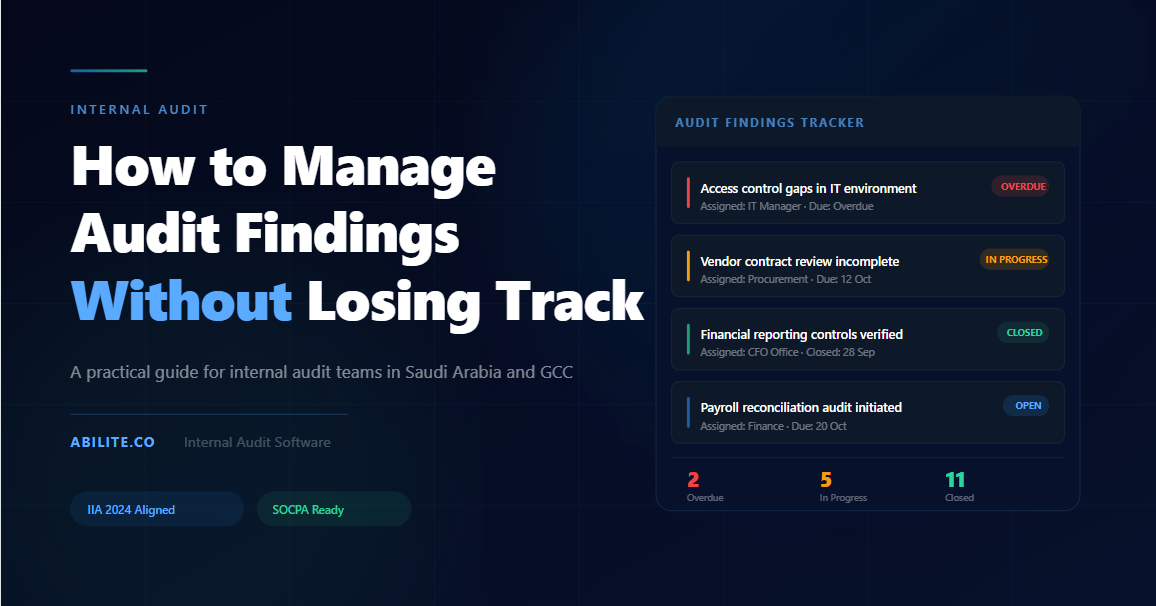
Audit finding follow-ups fall through the cracks. Management responses sit in inboxes. Supporting evidence is scattered across files. Then an Audit Committee meeting arrives and someone asks a simple question: What is the current status of this finding?
If answering that question requires opening spreadsheets, searching email, or asking several people for updates, internal audit findings management has become a reporting problem instead of a control process.
Effective internal audit findings management gives every finding a clear owner, priority, due date, action plan, evidence trail, and closure status. It also gives the Chief Audit Executive and senior management a reliable view of remediation progress.
What is Internal Audit Findings Management?
Internal audit findings management is the structured process used to record, evaluate, assign, monitor, verify, and close issues identified through internal audit work.
A strong process begins when an auditor documents a finding and continues until management has completed the agreed action and internal audit has confirmed whether the response is adequate.
The process should preserve the finding, root cause, risk, recommendation, responsible owner, target date, evidence, management response, and verification history in a controlled record.
This matters because findings are not simply items to report. They are part of an organization’s governance, risk, and control improvement process.
The IIA’s 2024 Global Internal Audit Standards include Principle 15, “Communicate Engagement Results and Monitor Action Plans,” with Standard 15.2 covering confirmation of the implementation of recommendations or action plans. The Standards became effective January 9, 2025.
For CAEs and Risk Directors, good findings management creates a defensible record of what was identified, who accepted responsibility, what action was promised, and whether the issue was actually resolved.
Why Audit Findings Get Lost in Traditional Workflows
Traditional audit finding management often breaks down for four practical reasons.
1. Clunky email chains and buried attachments
A finding may generate an email to a process owner, another email with management’s response, a spreadsheet attachment, evidence in a shared folder, and several follow-ups.
The information exists, but it becomes difficult to reconstruct the complete history quickly.
2. Fragmented manual tracking
Teams often use spreadsheets for finding registers, email for reminders, shared drives for evidence, and documents for reports.
Each tool may work individually, but the workflow becomes dependent on manual updates and reconciliation.
This also creates a data consistency problem. If an owner changes a target date in one file but the reporting sheet is not updated, the audit team can end up working with conflicting information.
3. Unclear ownership and accountability
A finding without a clearly assigned action owner can remain open even when everyone assumes someone else is handling it.
Effective audit finding management should make responsibility, action, priority, and due date visible.
4. Deadlines are recorded but not actively monitored
A target date in a spreadsheet does not automatically create accountability.
Overdue items can remain unnoticed until the next review or Audit Committee meeting. A mature process needs reminders, escalation rules, and clear status visibility.
The objective is not simply to maintain a list of findings. It is to create a controlled process for moving each issue toward verified resolution.
The 5-Step Process for Internal Audit Findings Management
A practical framework can turn internal audit findings management into a controlled workflow.
1. Standardized Finding Capture and Categorization
Start with a consistent finding record.
Capture the issue, condition, criteria, cause, consequence, risk rating, recommendation, management response, owner, and target date.
Standard categories and risk ratings make later reporting more useful. They also allow the audit team to identify patterns across departments, business units, and audit periods.
2. Actionable Remediation Ownership and Assignment
Every agreed action should have a named owner and a defined completion date.
If several actions are required, assign each one separately rather than treating the entire finding as one task.
Modern platforms such as Abilite can keep the finding, action owner, status, and supporting information connected rather than requiring the audit team to reconcile separate files.
3. Automated SLA and Deadline Tracking
Set reminders before deadlines and escalation rules for overdue actions.
This reduces dependence on manual follow-up and creates a more consistent record of communication and status changes.
For high-risk findings, escalation can also be structured around predefined thresholds so significant overdue actions receive appropriate attention.
4. Real-Time Verification and Closure Workflows
Closing a finding should not mean changing a spreadsheet cell to “Closed.”
Internal audit should be able to review evidence, assess whether the action addresses the finding, document verification, and record the closure decision.
The IIA Standards specifically address confirming implementation of recommendations or action plans under Standard 15.2.
5. Executive Reporting for the Audit Committee
Senior stakeholders need more than a list of open findings.
They need visibility into high-risk issues, overdue actions, aging, ownership, remediation progress, and recurring themes.
A centralized findings dashboard can turn the underlying records into management and Audit Committee reporting without requiring the audit team to rebuild the information manually for every meeting.
How Dedicated Software Transforms Finding Remediation
Dedicated software changes audit finding management from a periodic spreadsheet exercise into an ongoing workflow.
Instead of asking the team to remember which findings need attention, the system can surface upcoming deadlines, overdue actions, outstanding evidence, and items awaiting verification.
Instead of rebuilding a report before every Audit Committee meeting, the team can work from current records and standardized statuses.
The benefit is not simply fewer spreadsheets. The larger change is greater control over the remediation process.
When ownership, deadlines, evidence, communications, and verification are connected, the CAE can spend less time reconstructing status and more time evaluating whether significant issues are actually being addressed.
Abilite’s public customer material includes a statement from the Almana Group of Hospitals’ audit department head that, before Abilite, internal audits were time-consuming and fragmented, and that Abilite helped streamline audit planning and reporting across hospital units. The published customer statement does not provide a quantified remediation-speed result, so it would be inappropriate to attribute a specific remediation improvement to Abilite without additional evidence.
Key Features to Look for in Internal Audit Findings Management Software
When evaluating internal audit findings management software, look beyond a basic issue register.
Useful capabilities include:
- Automated follow-ups and escalation paths for approaching and overdue actions
- Real-time Audit Committee dashboards and analytics for management-level visibility
- Centralized evidence collection and document management for supporting remediation records
- Granular role-based access control and clear ownership trails to establish accountability
- AI-driven risk scoring and insights, where outputs can be reviewed and governed by the audit team
The software should also preserve an audit trail, support configurable workflows, and make it easy to move from an individual finding to portfolio-level reporting.
A strong internal audit findings management platform should therefore connect the complete finding record, rather than simply replacing one spreadsheet with another digital register.
Audit tracking software checklist for verified issue closure
Audit tracking software is most useful when it preserves the complete action history, not just an open or closed label. Use a sample overdue finding to test the following steps during evaluation.
- Assign ownership. Record a named action owner, the agreed response and the target completion date. Split separate corrective actions into separate responsibilities.
- Preserve changes. Check how revised dates, management updates and supporting documents remain connected to the original finding.
- Review evidence. Ask the owner to provide completion evidence, then have the reviewer document whether it addresses the issue. A submitted response and a verified closure should be distinguishable.
- Handle overdue actions. Demonstrate how the team identifies late actions, escalates significant delays and records the next review.
- Report the current position. Confirm that the individual finding and management summary show consistent ownership, risk, due date and verification status.
For example, consider a finding about inactive user accounts. A statement that accounts were reviewed is different from dated evidence of the review, its exceptions and the corrective action. Agree on the evidence and reviewer acceptance criteria before closure.
Use the internal audit management software selection checks to evaluate these steps alongside planning, working papers and reporting. Bring an anonymized finding to the demonstration and ask to follow its complete history.
Ready to Improve Your Findings Management Process?
If your team still spends significant time chasing updates, reconciling spreadsheets, and preparing manual finding reports, it may be time to examine the workflow itself.
Ready to eliminate tracking friction? See how Abilite manages audit findings for leading teams across Saudi Arabia and the GCC.
See how Abilite manages audit findings
For Arabic-speaking stakeholders, share our صفحة برنامج المراجعة الداخلية في السعودية before the demonstration so the team can review language and deployment requirements together.